I read an article on how Shanghai schools teach math differently from western schools. They mentioned that Shanghai teachers taught mastery before moving on to the next concept. I remember this well. My daughter spent her 1st grade year in an Asian school. They spent a couple of months on number bonds. It seemed so basic but they drove it home over and over again. She became a master at number bonds and it laid the foundation for mental math. She still loves math.
Then, I homeschooled for a while and our math curriculum used the spiral method. Teaching a concept, then another, and another, and then coming back around and going a little deeper. Revisiting each concept a little deeper each time. My daughter is now in the spiral method in her current school. She’s not a fan yet. “We’ve already done this!” she tells me often.
My heart resists relearning things I thought I knew, too. It can be a book of the Bible I’ve read quite a few times and know. Or a concept like forgiveness…yeah, I know those verses. I hear it in time with others and in my own journey of spiritual growth. I’ve already been here! Are we really talking about this again? I know this!
Yet, the Spirit speaks again in a small, soft, ever deeper way and I discover there’s another thing or two or a million I need to learn about forgiveness, grace, or obedience. The spiral concept of learning. I see it play out.
I am beginning to realize the freedom it brings. The desire for spiritual mastery is strong. To know a truth inside out and always know it, like your math multiplication facts or the ABC’s feels good. Who doesn’t want mastery? It feels so good to know something.
But, from the stories shared in the accounts of Jesus’ life and ministry, Acts, and Paul’s letters, I see a different method at play. Disciples felt they mastered concepts and then were shown how far they were from mastery. Learning, relearning, re-relearning. The spiral method.
I find freedom as I accept the spiral method over the mastery method in growing in my walk with Jesus. It also brings freedom as I endeavor to shepherd others too. Releasing mastery gives us all a breath of fresh air as we abandon the expectation that we can be done learning at some point because we somehow mastered the Christian life.
Letting go of the disappointment of failed mastery allows me to embrace the wonder that I can always, always learn new things about an old thing from God. My lessons are never over, He always keep coming back to make sure I’m getting it. It can be pretty painful and definitely humbling.
The spiral method. May I not act like a brat when presented with a lesson I thought I mastered!
In what ways do you see the spiral method at work in your relationship with Jesus?
When my father got sick, I wrote about it in real-time. A few of those blog posts were widely shared and read due to the circumstances of his sickness and death.
Did I exploit his situation? I knew he did not think so. He was more than happy for many more to hear about his life in Christ, even while his body was dying. But, the thought lingered.
Recently, I listened to a podcast by Michael Hyatt titled Keys to Writing a Killer Blogpost. I highly recommend it. At one point, Hyatt mentions the concept of stewarding our lives. Stewarding our stories. Stewarding our suffering. It resonated with me.
Hyatt’s podcast fleshed out in words what I hoped for and still hope for through my writing. In some way, I wanted to steward my dad’s suffering. Beyond that, I want to grow in stewarding my own.
So, what is a steward?
A steward is by definition in Merriam-Webster’s: one employed in a large household or estate to manage domestic concerns (as the supervision of servants, collection of rents, and keeping of accounts). Or, one appointed to supervise the provision and distribution of food and drink in an institution.
A steward is a manager. At best, they are fair and look after those affairs given to them in honesty. At worst, they are insubordinate, embezzling and neglecting their responsibilities causing people to suffer so they can gain. I imagine a mediocre steward fails to recognize the importance of their job.
Hmm.
I’ve failed miserably at stewarding other hard things in my life to the hurt of some very dear to me. Lately, I sense that every day I am faced with the invitation to be a steward. Sometimes its my own situation I must steward. At times, it is someone else’s.
What does it take to be a good manager of what God entrusts to me? It starts with turning away from some common lies about our master.
God doesn’t care about my suffering…
Sometimes I feel like I am working at a distance from God. I’m in a cubicle, one of many. I’m an ill prepared employee blaming my boss. He’s not around to know how hard it is and He didn’t send me to that training. I grow resentful.
I see the opposite of a distant and uncaring God in the Bible when Jesus weeps at Lazarus’ death. When the Israelites’ cries came before God in heaven while they were in Egypt. He was merciful to them in the desert, knowing their weakness and giving them time to heal. He saw Haggar. Saul persecuted the early church. Jesus asked him at his conversion, why are you persecuting Me? Not, why are you persecuting them but why are you persecuting Me.
God is not unfeeling. He does care. Because He is omnipresent, He is never absent.
My suffering is mine to bear alone, not burden others with…
No one wants to be needy. Problem is, we are all needy. To not be needy is to be God, completely self-sufficient, which makes Him the best provider for our needs. Our suffering is close to God’s heart and we must bring it there first.
But, we must also bring it to others in the family. Paul writes that when one member suffers, we all suffer with them. We comfort with the comfort we receive from God, and are called to give and receive comfort.
Sadly, not all will suffer with you. I have not always suffered with others. Those failures still grieve me. They also teach me in many painfully good ways what it is to stand alongside others better in their suffering now. I can never take back the salt I poured on wounds, but Jesus paid for that too and He can heal that in my friend’s life as well.
As I learn to share my suffering with God and others, I learn to carry others as well. I expect it to make churches and communities warmer places as we carry suffering, because we all suffer.
I should share my hard times when I’m over them…
Sharing struggles against temptations, failures, and doubts in real-time is challenging. It feels like what’s better is to share how I used to struggle. And, some hard times do need to resolve a little with limited counsel to steward them well before crowds.
What happens when I share my temptations, failures, and sin in real-time is that it often takes the power of secrecy and darkness away. Just like many of my hardest moments mentally seem to be in the dark of literal night, so struggles and failures against sin rage when they fester out of the light of the One readily available and able to fight them.
Bring them into the light with a trusted and mature person well versed in the Word and life, and it is like turning on a light in the middle of the night. Things are clearer, brighter, and usually a bit more hopeful. I thank God for the many women and men, too, who have turned on the light in the dark room of my soul.
On the Job Training
There is no way a blog post could exhaust this topic. I know I haven’t grown fully into my job description as a wise manager. I envision a painting (by an old master of course) of a steward depicting this aspect of my life in Christ more fully. I picture a person sitting at a table with provisions, a line of people in front of them, but also a kind master behind them whispering in the steward’s ear instructions regarding what is to be dispensed.
Listening to the master while facing the people strikes me as a good position to steward well. Maturity in Christ comes through on the job training.
How have you stewarded suffering well? Where do you stumble as a steward?
One minute it was 2016, then it was 2017 sometime in the middle of 10 Things I Hate About You, probably when Heath Ledger sings in the bleachers. Or maybe when Julia Stiles reads her poem to Heath in class. Great moments.
Anyway, 2016 passed to 2017 and I’m still surprised, trying to find my footing in a new year.
Last New Year’s surprised me too. It was the first of many markers that came and went without my dad. Christmas came and went rather uneventfully, but the new year brought more sadness than anticipated. Another year different from the one he died. Another year more of him not here with us. Something about that number change drove reality in deeper.
This year seems to be similar. Christmas came and went and I missed my dad in so many ways. But a new year put another year in between then and now and it just feels like a really, really long time. Too long without his presence in my life and the lives of all who loved him.
It’s a dissonant note in a season of resolutions, moving on, organizing, cleaning, looking forward, gaining control. It’s weird to feel a stuck in the past. If I could just make a resolution, a plan, or buy a container for the mess, I’d be moving forward and that would feel good.
There are some things in our lives, though, that can’t be contained neatly. Like grief. And, there is so, so much I cannot control. Like my dad not being here with us. So much I must respond to when I wish I could just change it.
It reminds me of the woman in the wonderful book The Help who slip covered everything in her house in a desperate effort to be more than she was in reality, to cover the pain of what she felt was less than. Instead of face herself, she controlled everything and everyone around her to conform to her desired image. It cost her so much.
The dangers of slip-covering the reality of life are real. Even the sadness of something like losing a father.
So, today, with children back in school and the house quiet, I am endeavoring to respond to the life God has graciously given me before moving on. It means counting the joy and also counting the grief, resisting the urge to slipcover things that need stripping, and loving what needs to be embraced in its current state.
There are things I want from this year for sure, but to rush into those feels like building on sand. For today, I survey the terrain…and write because that’s how I do this reflection business.
A woman thrust the tomato plant into my hands when I displayed a mild level of interest. The pastors set up a garden behind the children’s wing and these were the leftover tomato plants, a bit bedraggled and needing a good home.
I couldn’t promise them the good home, but we have dirt in our backyard. I came home and put them in a large planter on a lark. Growing things is new for me.
We left a few weeks later for a 6 week trip during which a turtle died but our tomato plant flourished. It was a stunning discovery. It was large and hanging over the edge of the planter!
In adjusting back to the U.S. after so long in our former familiar culture, I needed a project to focus my attentions on. I would see this tomato plant through until it produced tomatoes. Picture a woman making a solemn vow.
I bought a cage, plant friendly insecticide, tomato fertilizer. Every day I checked on the plant which continued to grow. I read blogs and did weird things like shake the tomato plant vigorously so it would pollinate itself. Bees are scarce and I began feeling mildly panicked about our loss of the bee population in respect to my tomato plant’s chance of success.
Imagine my joy when I discovered small yellow flowers! Flowers lead to fruit. Tomatoes are a fruit! Tomatoes should soon come.
They did not. The flowers wilted and died without fruit. I got mad at the plant that failed to grow under my helicopter gardening. I stopped watering it and left it to itself in the 90+ degree September heat.
It sprang a tomato. Then another. What a tease! Fine, I thought. You’re doing so well on your own, I’ll let you continue that way. So I did.
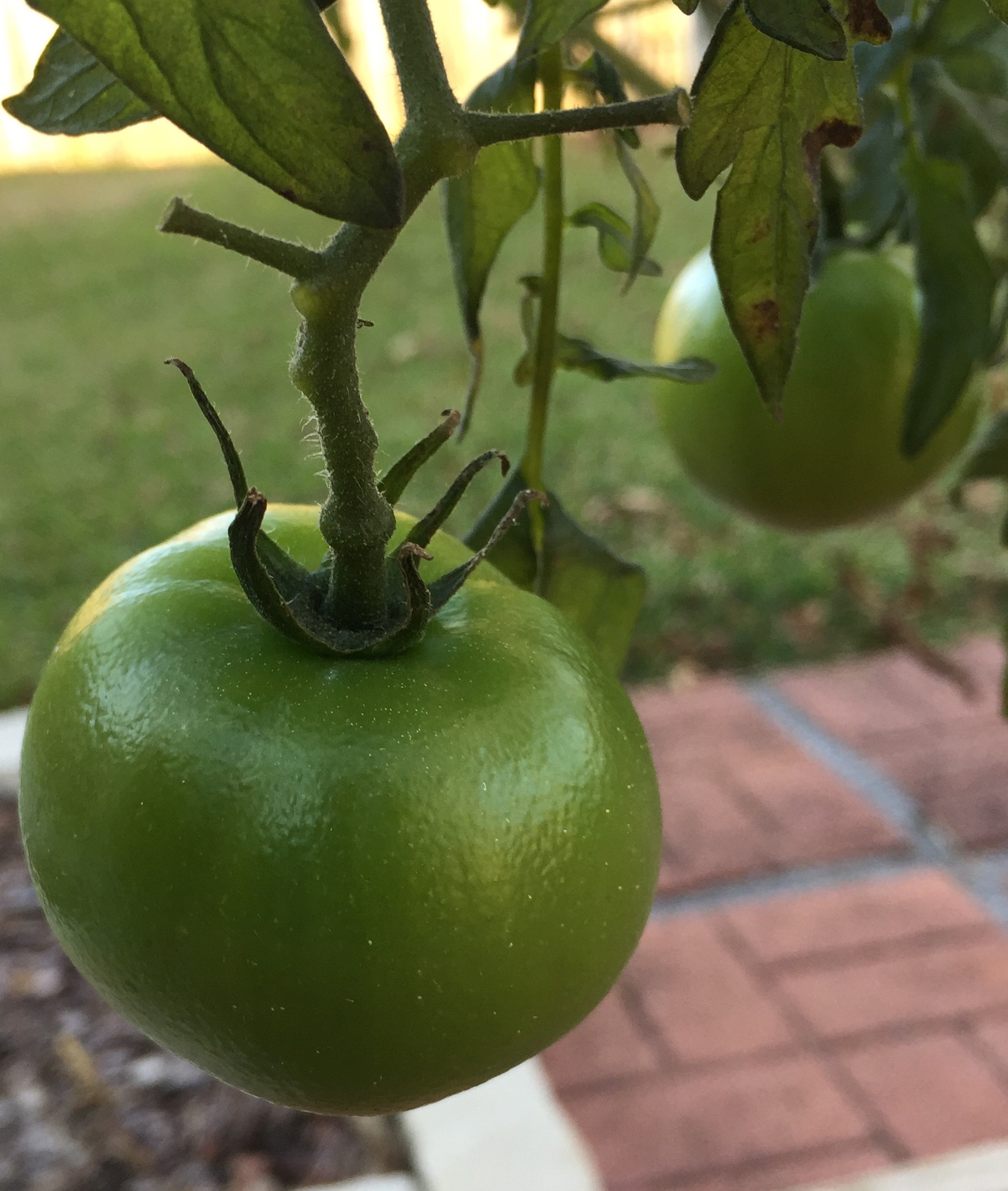
The tomatoes kept growing bigger and still green. I began checking on them again, these very expensive tomatoes.
Then it froze this week. 2 nights in a row of a bitter cold. I neglected the tomato plant. It lay out there cold and bare with no blanket to cover it. With Christmas and busyness beyond the norm, the tomato plant got the shaft.
I don’t expect any ripe tomatoes now. Just frozen green tomatoes turning to mush. May it yet surprise me.
About halfway through this tomato story, I began to wonder why I was writing this up? What does a tomato plant have to do with anything? Probably not much but its served as a visual reminder of principles my heart needs to know. A kind of wrap up on a fall of life and ministry.
So, here is what my tomato plant taught me…
Only so much is really under my control, and its a very little much.
Faithfulness in what is my part of God’s will is not promised to yield
Expectation of fruit is highly motivating, yet faithfulness is more steady a motivation
When fruit fails to come, its easy to get discouraged, resentful, and unfaithful to my task
God often chooses to remind me to trust Him for fruit by bringing it in unexpectedly and unrelated to the proportion of my efforts
Fruit purposely left on the vine and untended in harsh conditions is evidence of neglect and unfaithfulness
Yet, God can surprise and often uses harsh conditions to temper His children and make them hardier. He doesn’t waste anything.
Who knows, maybe I will get more than I deserve, more than frozen green tomatoes. It is supposed to reach back up near 70 this week.
But even if I don’t, my tomato plant experience revealed quite a bit about my spiritual life. I plan on trying again.
Gardening seems to be a God-given method to teach me His ways.
Most people don’t know what to say to the grieving. Most grieving don’t know how to talk about their grief. Mourning that comes out of time, during college-the days supposed to be the best of your life, can lead to profound loneliness.
And, I’m not just talking about the death of a family member or friend, maybe its the family relationship that was unspeakable, or the experience that stole what can never be physically restored, or a home lost due to an international move.
Not many know how to mourn among the old, so where does that leave the college student? Usually speechless. And angry. And searching for something to dull the pain. Surrounded by friends who do care, but may not have logged enough life to know quite how to come alongside their friend. It can be hard to know how to be a friend when you’re needed most.
I’m no grief expert, but I can share what I’ve learned along the road from a college student with few recognized losses in life to now, mid way through life having logged a few. I’ve experienced losses related to life lived overseas. A year and a half ago, my dad passed away of a brain tumor.
Entering back into U.S. college ministry, my heart weighs heavy for the many, many students I meet who are grieving and struggling to find a way through the grief.
Here’s a few things to keep in mind when walking alongside a friend through loss…
Begin understanding your own losses.Maybe you haven’t lost someone to death, but have you lost a friend or family member to a severed relationship? to a different direction in life? to addiction? Those are losses to grieve and mourning brings compassion for other losses.
Log time with your friend. Call them. Text them. Even when you don’t know what to say. Just say “I don’t know what to say”. It’s honest and it may be enough for the moment. Keep calling and texting even when it seems they don’t want to be your friend because they don’t call back. They’re grieving and it can be hard to take simple steps to maintain friendships during grief. Don’t take it personally and keep offering your friendship.
Allow space for a range of emotions. Grieving isn’t just crying. It can be laughing over a memory or just doing something normal to remind yourself that life isn’t all about your loss. It’s not all sad. It feels like a roller coaster sometimes. Being a friend who is there means you are along for the ride, with all its ups and downs.
Avoid explanations. Most of the time, we really don’t know what God’s purposes are in the timing of loss. When a friend of mine died right after graduation, a nurse rattled off a long list of false statements as we sat stunned out of words from the shocking news. The dead do not become angels. God probably did not take them because they were the prettiest. He does not need more angels in heaven because God does not need. As we sat bereaved in the hospital, my anger grew to overflowing. The best thing she could have given was silence. Statements and explanations make the speaker feel better, they have something to say. If you don’t know what to say, say that, and sit. You may feel inept and weak but that is ok. It’s a demonstration of selfless love. Presence is a profoundly comforting comfort.
Educate yourself. Watch movies like P.S. I Love You, Steel Magnolias, Stepmom, or Band of Brothers. Read memoirs written by the grieving. Do a word study in your Bible on mourning. Read slowly and repeatedly through Jesus’ interaction with Mary and Martha when Lazarus died but before he was raised. Listen to Mary and Martha’s responses as though you were there. Notice Jesus’ responses.
Pray for your friend and yourself. Most of the time when I pray for my grieving friends now, I pray that they will experience comfort from the Lord.
Get help when its needed. If your friend is coping with grief in self-destructive ways, don’t just stand by. If they’re binge drinking, coping oddly well but not willing to talk much with anyone, displaying poor hygiene that is beyond normal, taking drugs, hooking up with others to avoid pain, missing an abnormal number of classes, or unable to sleep well consistently, they need more help walking through their grief. Approach them about talking with a counselor and help them set up and keep the appointment.
Sometimes I’ve felt there should be a class where I can learn how to be compassionate. Alas, I believe God grows a heart of compassion in us as we experience pain and come close to those in pain.
So, you passed your driving license sight exam?” I knew I was going to be getting a prescription when she asked me that question. She assured me I’d notice a big difference when I got my glasses.
An assistant who seemed to have good style helped me pick out a pair of glasses I was sure I’d just need while driving at night. They came in a week later. I put them on.
My baseboards are nicked everywhere. I can see blades of grass in my backyard, read signs from a bizarre distance, distinguish shapes at night, and notice every dust bunny in my house with my bionic eyeglasses. Oh, and our TV is suddenly much better quality than I thought.
Its not like I haven’t worn glasses before. Anyone who grew up with me knows I was very nearsighted and wore glasses constantly. Then I had those gas permeable contacts which are really torture devices when combined with the smallest bit of dust. Then subjected myself to LASIK, wonder of wonders! I didn’t wear glasses for 16 years.
But, when you get older, eyes change. I knew this but slow change is like being cooked in a pot of water. I didn’t notice the gradual differences mounting up.
What took me in to the optometrist, besides not having my eyes checked for a ridiculously long time, was a growing fear of driving at night. I had a suspicion I wasn’t seeing as clearly as before. I also noticed I could see more dirt in my house when I got closer to the floor.
You’re noticing I’m not really bright. Takes me awhile to put two and two together…and get the right answer!
So, I knew I needed glasses but this radical transformation was a little more than I anticipated. Realizing how much my bad vision distorted my perception was a wake up call. I came to believe over time it was the TV’s fault or my night vision just wasn’t that good.
My problem, by default, was out there. This distortion led me to think I was keeping my house decently clean and the trim paint was ok. Oh, and that we should’ve spent more on a TV because ours wasn’t that sharp! Weren’t these new TV’s supposed to have higher resolution?
Add corrective lenses and I realize the problem was me–not the TV. Ironic that what corrects a problem with seeing out there, reveals how much I put store in my own faulty estimation of the world.
I believed what I saw until I was corrected. We all do. It’s our fatal flaw, this tendency to start from our selves instead of God to define truth. We forget we are imperfect. We grow comfortable believing our take on life until it just isn’t working like it used to, or did it ever?
It’s tempting now to take off my glasses when I don’t want to see all the imperfections and chores I need to do. Strange how I know it doesn’t make the dust bunnies go away… but it makes the dust bunnies go away!
I don’t take them off to watch TV, in case you were wondering.
We sat and waited,my brother and I, all dressed for the Christmas Eve service at our Bible believing evangelical church. Somber colors were the tradition for men. Black suits, white shirts, maybe a Christmas tie or a daring green sweater would be seen in the narthex, a fancy word for the place where children wait for their parents to leave church.
My brother and I loitered around the living room, waiting for our parents to come down the long hallway ready to go to the service. Would he wear them, we wondered? Would this be an off-year? We never knew until we heard his footsteps and he turned the corner.
He liked to present himself holding his hands out to the sides, squatting a little with a goofy smile. A “ta-da” befitted his presentation though I’m not sure he ever said it. He just acted it. And we knew he was wearing the pants.
They were hard to miss. Brilliant red, black, green, and yellow plaid pants. A little tight after 20 years of ownership and life. A little short, a side effect of the little too tight. They did not break at the ankle as well-fitting traditional pants should. Tight rolling was the phenomena of the early 90’s. These pants were bell bottoms.
The pants were social suicide we knew we’d never live down.
We usually protested a little but we knew it was a lost cause. We rolled eyes. Groaned. Some years he changed in response to our complaints, but most he stuck with the pants, loyal to a fault. One year he wore a white sweater he probably got the same year as the pants.
Pendleton! Mom reminds us when we laugh about this story that lives on in legend at the family dinner table. They were nice, Pendleton wool pants! As though our roasting was unbefitting the dignity of Pendleton wool with its long history quality and tradition. She was personally invested in the pants and may have even bought them as a gift in their early married days when they were in style.
The joke’s on us now. Pendleton is back in the cool column now. I eagerly expect to see a hipster with a weird beard and funky glasses at church wearing my dad’s pants this year along with a vintage white sweater. Different is cool. Tacky is a sign of courage and independence.
My dad was a man before his time. A hipster before hipster was hip. We didn’t appreciate his genius.
And it was genius. His slightly snotty teenagers needed a little bit of his devil-may-care attitude. I was too much concerned with others. I missed out on the levity of not caring what other people thought. Of trying to climb the social ladder that never ended. Only as an adult and a parent do I see what a gift his red pants were to us.
My dad when the pants were first in style.
My teenage self found that the world kept spinning. We were no more and no less socially advantaged by our dad’s pants when school started back up in January. I lived, and I laugh more and care a little less because of those pants.
The pants made fewer appearances as the years went on. Sadly, we don’t know where they are now. My dad is with the Lord, probably reunited with his red pants, and my kids are approaching those teenage years when people loom large.
I may just have to find my own pair of Christmas pants to continue the tradition of bringing the world into perspective.
I always flip the channel when the zombie previews air. With three youngish kids around, I notice a direct correlation to sleepless nights and the walking dead. I don’t sleep and I like sleep. They don’t sleep so I don’t sleep. Nobody sleeps and we become the walking dead we tried to avoid by flipping the flippin’ channel!
Ok, joking and sleep issues aside. There is something to this whole zombie apocalypse thing. As much as I want to call foul, evil, and bad every time the walking dead comes on air, it strikes a deeper tone to me.
Whoever conceived this idea of zombies is saying something important. There are the living dead, and they are among us. This show is a major, major hit. This message is resonating with people.
In the show its real zombies and, of course, we all know…hahaha…they don’t exist and you are only really afraid when your brothers prank you after your wisdom teeth are extracted, right?
I think it goes deeper than that, though. Artists write about these things because they think about them. They think about them because they are imaginative. They imagine them, I suppose, because they sense them. People watch this stuff because it is entertaining, and it touches on reality.
There’s some truth in what all this zombie stuff says.
People feel like zombies. I feel like a zombie in the early morning before coffee, late at night when I’m played out, and all times of the day when I’m jet lagged. I can identify physical reasons for my zombie-ness.
Many times I can also identify spiritual reasons for my zombie-like state. I’m mad at God. I’m mad at someone else. I’m sad. I’m grieving. I’m hopeless. Life is overwhelming. We go through the motions and no one notices we aren’t alive.
Some feel like zombies most of the time because their soul condition is fatal and their bodies are still alive. And they know it. And its true. They’ve never seen the cardiologist, they just know. Impending doom. Dead dread.
It’s the opposite of the living hope offered to us. Living hope is life-giving blood running through our spiritual veins, soft hearts of flesh, and woundable bodies because there is more to this life. Living hope comes through the blood of Jesus who died for us and provided the cure for the virus of sin that overtakes us.
My hope is those that feel like the walking dead in their soul and bodies would tell someone who understand the cure and extend it. It is the antidote to the death that will come to all of us in the flesh.
Our flesh speaks to this death. We all know we will die. It is a horror. It is shocking. And it is scary to watch.
While we will all die one day, death need not come to all of us in the soul. And, when the soul lives, the flesh will live again one day, too.
That is the living hope. Because of Jesus, though we die, yet we live.
The hope is not just for the deathbed, though, it is for the now, too. I may feel like a zombie sometimes, but it is not my true and permanent state.
We watered our lawn too much. My husband told me this after consulting other lawn experts, otherwise known as neighbors. He talks about lawns like I talk about cooking.
If we water our lawn too much the roots don’t learn to grow deep and seek out water on their own. Who knew? Well, other people is the short answer. Seeking roots are important when it gets hot and dry. It’s Texas. It gets hot and dry.
So, we backed down on our watering, but not before we felt the pain of our utility bill. Yikes! The first year of home ownership is a year for learning. What that really means is a year of doing lots of weird things because you don’t really know what you’re doing.
Now its summer again and I find I like my lawn to be green and its starting to get a tad light green in patches. I really want to ramp up the watering so it gets dark green again. I’m scared the grass won’t find the water.
What if it dies?
My own life, my kids lives, the lives of students I work with on campus. I see the same truth play out. Surface green looks so good and there’s really nothing wrong with seeing outward growth and health.
The big question is what kind of roots are being trained? Are they seeking roots trained to strain towards sustenance? Am I? Or weak shallow roots that don’t know what to do when drought comes?
When dry threatens, I want to ramp up the watering schedule. It looks good and works fast. And its appropriate at times, too. The lawn gets green pretty quick when I water it more. More attention pays off in the present tense.
But hot and dry always come at some point and not just in Texas.
How have I trained the lawn? How am I training my spiritual life? My children? Am I trying to help so much that I train shallow and weak people who don’t know what to do when hot and dry come in life? Am I afraid that answers won’t be supplied from the depths so I feel I need to supply from the surface?
Watching my kids struggle to stretch roots down to the foundation of things is difficult. Feeling the pain of it myself is confusing.
Searching for depth is just that…a search.
It is a lack of knowing exactly where the sustenance is but sending out feelers, shoots to investigate. It looks like absorbing long passages of God’s word, the Bible, gleaning and sifting for who God is in new ways. Sometimes searching is finding nothing that feels helpful but absorbing more truth. Later it makes more sense. Or, seeking is trying new things to discover where I fit in the body of Christ. Learning new skills necessary for a new circumstance in life is a form of stretching to new depths.
The assurance I have is that I will find sustenance, and others will too, if we search for that which truly sustains. It may not always seem enough or produce a green enough lawn to look pretty to everyone, but God will keep me growing spiritually when I am connected to Him, the Giver of life.
My lawn may not look as green as everyone else’s. That’s a challenging reality at times. I am learning again to trust that the exterior appearance of life doesn’t always correlate directly to spiritual health.
Next time I will write about the tree that looked dead for months. Spoiler alert. It’s not dead!
Deep roots, searching roots, trained to send out feelers into the depths during the hot and dry times is health more than shallow and green during ideal conditions.
I lay on the couch in the morning sun flipping through my photo feed. Memories wash through with each swipe. Sunshine to snowfall. Normal to hectic. One life then another. Change after change after change.
Some photos remind me of things forgotten in the crash of my father’s sickness. The dark chocolate bar the writers gave me upon the publication of my first piece. A monumental event, an event eclipsed by news delivered 2 days later.
Two swipes later clouds and snow from the seat of a flight booked last minute. Then, my parents on face time with family figuring out how to process a terminal diagnosis. Hospital photos, prayer meetings, more clouds from more flights all mixed in with children at school events, moving trucks, beach sunrises and meals at favorite restaurants, hospital room views.
All jumbled together in an impossible array of the unbelievable.
I wonder how we made it, and I remember how we made it. It was life in the moment of what had to be done, constantly shoving aside what must wait until later. Daily listening to my gut when it said weird things like go shopping, buy a nice outfit for each kid for the funeral. Or listening to my friends, buy the tickets, don’t worry about the money.
Coming to accept more deeply that life isn’t as neat and clean as we want, and we can’t make things as neat and clean as we want no matter how hard we try.
Somehow we made it. Somehow we cherished the moments given to us and came through. Scarred, yes. Hurting, definitely. Intact, physically, yes.
And missing.
Always missing what was taken from us in this world. Hopeful and waiting for the day of reckoning. The day of returning what we are promised in Jesus Christ. Life, joy, peace, and fellowship with the ones we love.








 eternalwaitofglory